Launch Tensions: SpaceX Declines Military Work While Starship Faces Refueling Hurdles
A series of developments this week highlights the complex balancing act between commercial ambitions, military partnerships, and the engineering challenges of deep space travel.
By Tunde Adeyemi ·
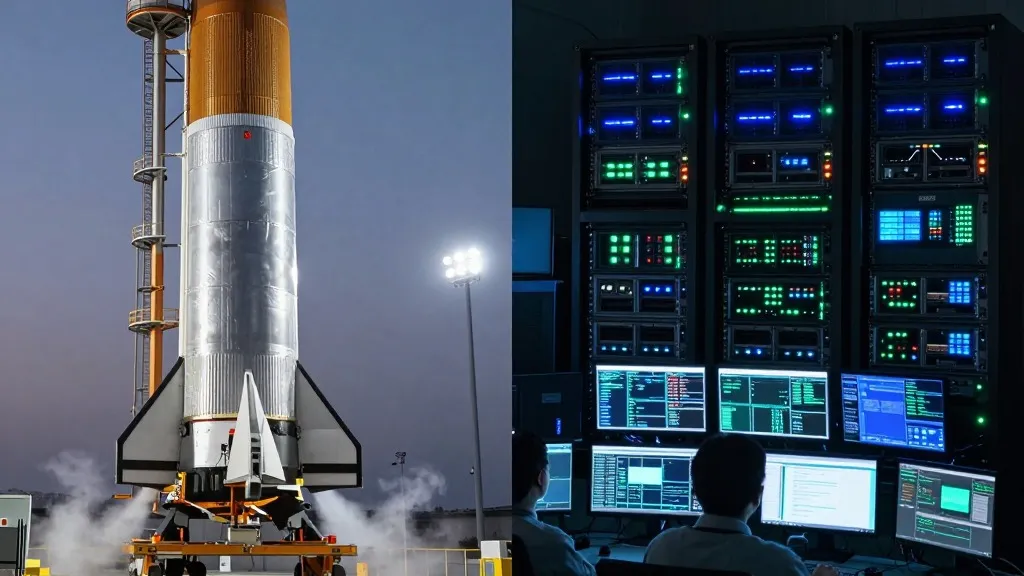
The commercial space sector is currently navigating a period of significant friction, characterized by a notable divergence between private enterprise priorities and government procurement strategies. This week brought a wave of conflicting signals regarding the role of major launch providers, with one of the industry's leading firms explicitly distancing itself from certain military opportunities while simultaneously facing new technical scrutiny on its flagship deep-space vehicle. These developments underscore the growing complexity of the modern launch landscape, where capital allocation, safety protocols, and geopolitical needs intersect in increasingly unpredictable ways.
In a surprising move that caught industry observers off guard on Thursday, SpaceX informed the U.S. Space Force that it would not be accepting three offered military launch contracts. The company’s decision to decline the government business marks a distinct shift in its recent trajectory, suggesting a strategic focus on other areas of its portfolio or a reassessment of the financial and operational demands placed on its infrastructure by defense missions. This rejection highlights the ongoing negotiation dynamics between the world’s most prolific launch provider and the U.S. military, which has historically relied on SpaceX for a significant portion of its launch cadence.
While the military news generated immediate headlines, a parallel development on the civil space front revealed potential bottlenecks for the company’s most ambitious project. A NASA safety panel has indicated that SpaceX’s Starship vehicle may require as many as 22 in-orbit refuelings to support a lunar landing mission. This figure suggests a higher complexity and risk profile for the lunar program than previously modeled, raising questions about the timeline and feasibility of sending crew to the moon using the current orbital refueling architecture. The panel’s assessment serves as a critical checkpoint, forcing engineers and mission planners to re-evaluate the logistics of propellant transfer in the vacuum of space.
Across the Atlantic, European launch startups are making steady, if incremental, progress toward establishing a competitive presence in the small-lift market. PLD Space, a Spanish-based company, reported that its Miura 5 rocket is nearing final integration for its inaugural flight. The vehicle is scheduled for its first launch before mid-2027, marking a significant milestone for the company’s efforts to provide accessible access to low Earth orbit. The progress comes as the company continues to refine its production pipeline, leveraging lessons learned from earlier qualification campaigns to streamline the manufacturing process for operational vehicles.
According to an October 19 program update, PLD Space has already manufactured three Miura 5 rockets, with the primary goal of the latter two being the qualification of key system elements. CEO Raúl Torres noted that producing these three vehicles has allowed the team to work continuously across different stages of production, directly applying insights from each qualification campaign to the eventual launch vehicle. This iterative approach aims to reduce technical risks before the first operational flight, ensuring that the system is robust enough to handle the demands of spaceflight.
Specific components of the Miura 5 are currently undergoing rigorous testing at PLD’s facility in Teruel. One second stage has been fully integrated to begin system-level testing under conditions that mimic actual operating environments. This stage is undergoing a qualification campaign that includes a wet dress rehearsal and a static hot-fire test. These tests are critical for validating the structural integrity and performance of the engine and propulsion systems, providing the data necessary to certify the rocket for its maiden voyage.
In North America, the competitive landscape is shifting as Canadian startups seek to secure the capital needed to scale their operations. Reaction Dynamics, one of three prominent launch startups in Canada, announced it is seeking to raise $350 million. The funding is intended to expand the company’s workforce from its current 68 employees to more than 350, a significant growth plan that reflects the company’s ambition to move from development to active production and launch readiness.
Reaction Dynamics is developing the Aurora rocket, a small-lift vehicle that the company hopes will reach orbit by 2028. In addition to this near-term goal, the company has outlined plans for a medium-lift rocket named Borealis, with a debut targeted for 2031. This dual-rocket strategy indicates a long-term vision for the company, aiming to capture a broader segment of the launch market as it matures. The raise of capital is a crucial step in this strategy, providing the resources needed to build out the infrastructure and hire the talent required to meet these aggressive timelines.
Source: Ars Technica